How AI is Transforming CNC Manufacturing
The manufacturing industry is entering a new era of intelligence, automation, and efficiency. As global competition intensifies and labor costs continue to rise, manufacturers are increasingly investing in advanced technologies to improve productivity and quality. Among the most significant developments in 2026 is the rapid adoption of smart jigs and fixtures, powered by artificial intelligence, sensors, and predictive analytics.
For CNC machining companies, aerospace manufacturers, automotive suppliers, and industrial equipment producers, intelligent workholding systems are becoming essential components of modern production lines. Smart fixtures are no longer simply mechanical tools for positioning parts—they are evolving into data-driven systems that actively contribute to manufacturing performance.
What Are Smart Jigs and Fixtures?
Traditional jigs and fixtures are designed to securely hold workpieces during machining, welding, assembly, or inspection processes. While they remain critical for ensuring precision and repeatability, conventional fixtures operate passively and provide little feedback about production conditions.
Smart jigs and fixtures integrate advanced technologies such as:
- Artificial Intelligence (AI)
- IoT Sensors
- Real-Time Monitoring Systems
- Machine Learning Algorithms
- Automatic Position Compensation
- Predictive Maintenance Software
- Wireless Data Communication
These intelligent systems collect and analyze operational data, allowing manufacturers to optimize production processes, reduce downtime, and improve overall equipment effectiveness (OEE).
Why Smart Fixtures Are Becoming an Industry Trend
The rise of Industry 4.0 and the transition toward Industry 5.0 have accelerated demand for intelligent manufacturing solutions. Companies are under increasing pressure to improve efficiency while maintaining high product quality.
Several factors are driving the adoption of smart workholding systems:
Increased Demand for Automation
Manufacturers are seeking ways to reduce reliance on manual operations and achieve higher levels of automation. Smart fixtures help automate setup verification, workpiece positioning, and process monitoring.
Shorter Production Cycles
Modern manufacturing often involves smaller batch sizes and more customized products. Intelligent fixtures enable faster changeovers and flexible production scheduling.
Labor Shortages
Many industrialized countries continue to experience shortages of skilled machinists and production technicians. Smart systems help bridge the gap by reducing operator dependency.
Higher Quality Requirements
Industries such as aerospace, medical devices, and automotive manufacturing require strict quality standards. Smart fixtures provide real-time feedback to ensure dimensional accuracy and process consistency.
How AI Is Transforming CNC Manufacturing
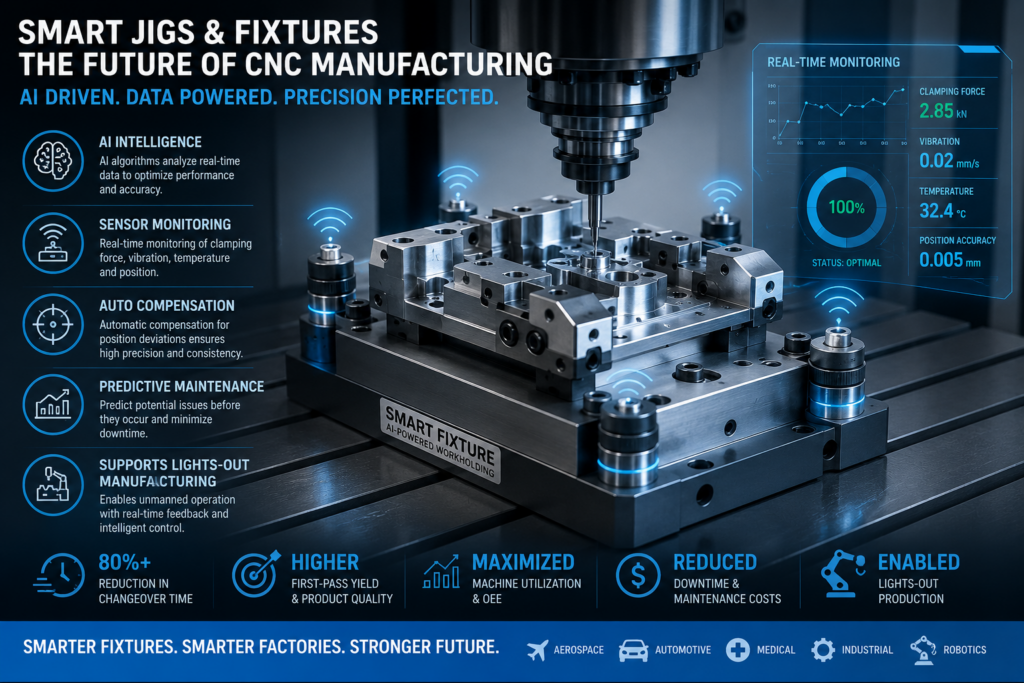
Artificial intelligence is rapidly changing how CNC machining operations are managed. By combining AI with intelligent fixtures, manufacturers gain unprecedented visibility into production performance.
Real-Time Process Monitoring
Integrated sensors continuously monitor:
- Clamping force
- Vibration levels
- Temperature
- Tool wear
- Fixture positioning accuracy
AI algorithms analyze this data and identify potential issues before defects occur.
Automatic Position Compensation
One of the most valuable capabilities of smart fixtures is automatic compensation for minor positioning errors.
Using sensor feedback, the system can:
- Detect misalignment
- Correct positioning deviations
- Improve machining accuracy
- Reduce scrap rates
This is particularly important for high-precision CNC machining applications where tolerances are extremely tight.
Predictive Maintenance
Predictive maintenance is becoming a key advantage of AI-driven manufacturing systems.
Instead of relying on scheduled maintenance intervals, smart fixtures monitor their own condition and predict when maintenance is required.
Benefits include:
- Reduced unexpected downtime
- Longer fixture lifespan
- Lower maintenance costs
- Improved production planning
Manufacturers can address potential problems before equipment failure occurs, maximizing machine availability.
Benefits of Intelligent Workholding Systems
Faster Setup and Changeover
Traditional fixture changes can consume significant production time.
Smart fixture systems can:
- Store setup parameters
- Automatically verify positioning
- Guide operators through setup procedures
Many manufacturers report setup time reductions exceeding 80%, significantly improving productivity.
Improved First-Pass Yield
The first-pass yield rate measures how many parts meet specifications without rework.
By ensuring consistent positioning and monitoring process variables in real time, smart fixtures help improve:
- Dimensional accuracy
- Surface finish quality
- Repeatability
- Production consistency
This leads to fewer rejected parts and lower manufacturing costs.
Enhanced Data Collection
Data has become one of the most valuable assets in modern manufacturing.
Smart fixtures continuously collect information that can be used for:
- Process optimization
- Quality analysis
- Production planning
- Continuous improvement initiatives
The result is a more efficient and data-driven manufacturing environment.
Support for Lights-Out Manufacturing
Unmanned production, often called “lights-out manufacturing,” is a major goal for advanced CNC facilities.
Smart fixtures play a critical role by:
- Monitoring workpiece security
- Detecting abnormal conditions
- Communicating with machine control systems
- Supporting autonomous operation
This enables manufacturers to extend production hours without increasing labor costs.
Smart Fixtures and Industry 5.0
While Industry 4.0 focuses on automation and connectivity, Industry 5.0 emphasizes collaboration between humans and intelligent machines.
Smart workholding systems align perfectly with this vision by combining:
- Human expertise
- Artificial intelligence
- Advanced robotics
- Real-time analytics
Rather than replacing skilled workers, intelligent fixtures help operators make better decisions and achieve higher productivity levels.
As manufacturing becomes increasingly complex, human-machine collaboration will be essential for maintaining competitiveness.
Applications Across Multiple Industries
Smart jigs and fixtures are being adopted across numerous sectors, including:
Aerospace Manufacturing
- Aircraft structural components
- Engine parts
- Precision brackets
- Titanium machining applications
Automotive Industry
- Electric vehicle components
- Battery housings
- Transmission systems
- Chassis assemblies
Medical Device Manufacturing
- Surgical instruments
- Orthopedic implants
- Precision medical components
Industrial Equipment
- Robotics components
- Automation systems
- Heavy machinery parts
The demand for precision, traceability, and efficiency makes intelligent fixtures particularly valuable in these industries.
The Future of Smart Manufacturing
As sensor technology becomes more affordable and AI capabilities continue to improve, smart jigs and fixtures are expected to become standard equipment in advanced manufacturing facilities.
Future developments may include:
- Self-adjusting fixtures
- Digital twin integration
- AI-driven process optimization
- Cloud-based production analytics
- Autonomous quality control systems
Manufacturers that invest early in intelligent workholding technologies will be better positioned to improve efficiency, reduce costs, and meet increasingly demanding customer requirements.
Conclusion
The adoption of smart jigs and fixtures represents one of the most important manufacturing trends of 2026. By combining AI, sensors, predictive maintenance, and real-time monitoring, intelligent workholding systems are transforming CNC machining and modern production environments.
Companies that embrace these technologies can achieve faster changeovers, higher product quality, reduced downtime, and greater operational efficiency. As Industry 5.0 continues to evolve, smart fixtures will play a critical role in building the intelligent factories of the future.
Keywords: Smart Jigs and Fixtures, AI CNC Manufacturing, Intelligent Workholding Systems, Smart Manufacturing Solutions, Industry 5.0, CNC Automation, Predictive Maintenance, Smart Fixtures, CNC Machining Technology, Industrial Automation Trends 2026.